SHENZHEN, GUANGDONG, CHINA, November 3, 2026 /EINPresswire.com/ — The Middle East gaming sector is undergoing an unprecedented expansion, propelled by strong youth demographics, high smartphone and PC penetration, and robust government initiatives supporting esports infrastructure. As competitive gaming shifts from a niche passion to a mainstream cultural and economic force across the region, demand for specialized hardware has surged. Esports venues, gaming cafes, and regional hardware distributors require peripherals engineered to endure intense operational demands while satisfying local aesthetic preferences. Navigating this expanding market requires identifying partners who balance manufacturing precision with deep visual and tactile tailoring. Finding a Professional Gaming Keyboard Supplier capable of delivering scalable customization and reliable hardware forms the foundation for successful regional distribution.
Step 1: Evaluate Regional Environmental and Operational Demands
Selecting a peripheral supplier for the Middle East market begins with analyzing the unique physical and operational environments in which the hardware will perform. High ambient temperatures, airborne dust, and extended daily usage in commercial venues place heavy stress on keyboard mechanical assemblies and housing plastics. Suppliers must employ materials engineered to resist thermal degradation and structural warping.
Hardware specifications should reflect these rigorous demands through precise keycap composition and component shielding. High-grade double-shot keycaps, particularly those utilizing dual-color or three-color injection molding, retain structural integrity and surface legends despite millions of keystrokes. Internal assembly also warrants careful review; dust-resistant mechanical switches and reinforced structural plates prevent debris infiltration that leads to key chattering or intermittent signal delivery. Furthermore, regional distributors must verify that suppliers comply with international quality protocols such as ISO 9001:2008, ensuring that raw material selection, soldering consistency, and final assembly stress tests adhere to strict global standards across mass production runs.
Step 2: Assess RGB and Physical Customization Capabilities
Gaming peripherals across the Middle East display strong consumer demand for personalized aesthetic features, making RGB lighting and physical customization central to product strategy. A qualified supplier must offer comprehensive tailoring options beyond simple pre-set color profiles.
Lighting and Zone Control
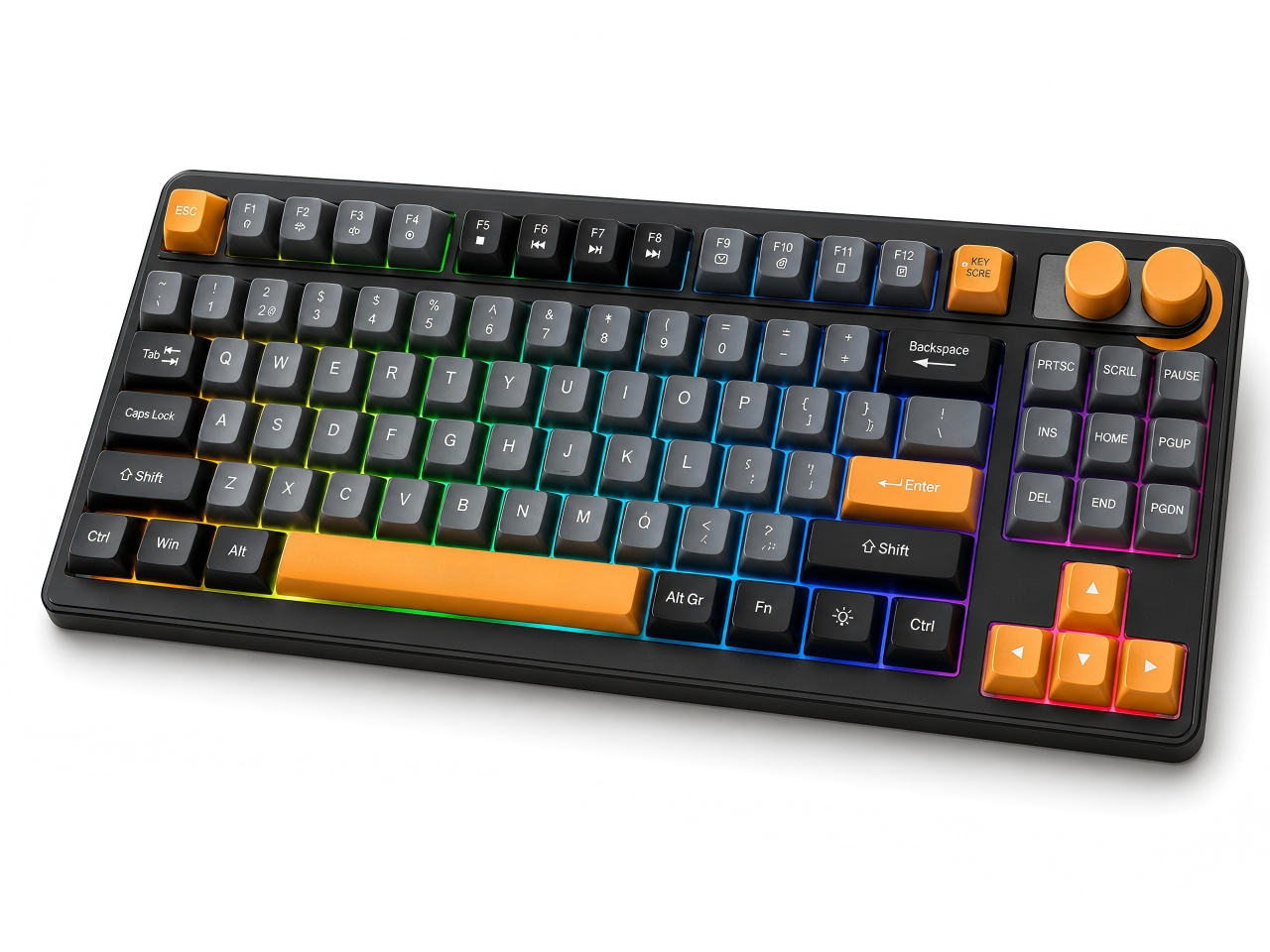
RGB integration requires sophisticated lighting controllers capable of dynamic per-key illumination, zone backlighting, and localized brightness adjustment. Advanced models incorporate dedicated hardware controls, such as physical brightness and volume knobs, allowing users to make real-time adjustments without interrupting gameplay or opening background software.
Aesthetic and Layout Tailoring
Customization extends to keycap colorways, housing finishes, and key legend options. Suppliers should support multi-tone keycap sets-such as striking 3-color keycap combinations-and precise dual-language legend printing, including clear, durable Arabic keycap layouts.
Firmware and Macro Programming
Hardware aesthetics must be paired with functional customization. Reliable suppliers provide dedicated software suites for macro assignment, profile storage, and custom key remapping, enabling distributors to offer products tailored to both casual gamers and competitive esports participants.
Step 3: Analyze Build Quality, Ergonomics, and Hardware Performance
Evaluating a keyboard’s internal architecture reveals critical distinctions between standard commercial peripherals and high-performance gaming hardware. While baseline models rely on cost-optimized components, professional-grade gaming keyboards integrate specific functional features engineered for competitive accuracy:
Details in internal structural reinforcement and PCB assembly directly affect operational longevity. A reinforced chassis minimizes flex during aggressive keystrokes, protecting internal solder joints from mechanical stress. High-grade contact switches ensure consistent actuation force and tactility across all key positions, preventing user fatigue during extended sessions.
Step 4: Examine Manufacturing Capacity, Lead Times, and Quality Assurance
Distributors entering volume supply agreements must examine a manufacturer’s underlying infrastructure. Relying on intermediary trading entities can introduce operational friction, communication delays, and inflated unit costs. Direct collaboration with an established original equipment manufacturer (OEM) and original design manufacturer (ODM) ensures end-to-end control over the production cycle.
A full-scale manufacturing partner like Shenzhen Deying provides the operational backbone necessary to fulfill large-scale regional orders. Operating a 12,000-square-meter facility staffed by over 500 skilled personnel, the factory integrates 10 fully automated assembly lines alongside more than 15 intelligent injection molding machines. This infrastructure yields a monthly production capacity exceeding 950,000 units, guaranteeing that high-volume orders for customized gaming peripherals move from initial tooling to final shipment without inventory bottlenecks. Direct factory oversight guarantees strict compliance with testing protocols, verifying signal integrity, key switch durability, and thermal resilience prior to packaging.
Step 5: Understand Product Limitations and Real-World Operational Boundaries
A transparent evaluation of gaming hardware requires recognizing functional boundaries to align products with appropriate usage scenarios. Multi-key anti-ghosting designs illustrate these operational distinctions. While a 19-key anti-ghosting configuration provides flawless registration for high-intensity gaming key combinations (such as movement keys, sprint, crouch, and action modifiers pressed simultaneously), it operates within a defined matrix. For specialized industrial software or extreme multi-user inputs on a single board, full N-key rollover (NKRO) architectures may be required.
Similarly, connection interface selection presents practical trade-offs:
USB-C Wired Architecture: Delivers zero signal latency, eliminates battery degradation, and avoids wireless spectrum interference common in high-density environments like LAN gaming centers or esports arenas. However, it imposes physical cable management requirements.
Integrated Control Knobs: Provide instant tactile adjustment for volume and backlighting, yet require housing space that increases overall peripheral dimensions compared to ultra-compact, minimalistic board layouts.
Acknowledging these trade-offs enables distributors to select precise configurations matching specific retail or commercial gaming deployment goals.
Strategic Procurement for Middle East Gaming Infrastructure
For Middle East hardware distributors, gaming venue operators, and e-commerce brand owners seeking to capture growing regional demand, sourcing optimized peripherals requires a balance of tailored aesthetics, robust build quality, and direct manufacturing scalability. The DEYING RGB Customization Series addresses these requirements by integrating high-durability 3-color keycaps, dedicated volume and illumination adjustment knobs, precise 19-key anti-ghosting matrices, and responsive USB-C wired connectivity into a proven OEM/ODM manufacturing framework.
To evaluate technical specifications, review custom tooling options, or initiate sample prototyping for your regional product line, connect directly with the engineering team at https://www.dykeyboard.com/ to map your volume procurement requirements.
DEYING
DEYING
Legal Disclaimer:
EIN Presswire provides this news content “as is” without warranty of any kind. We do not accept any responsibility or liability
for the accuracy, content, images, videos, licenses, completeness, legality, or reliability of the information contained in this
article. If you have any complaints or copyright issues related to this article, kindly contact the author above.

Media gallery